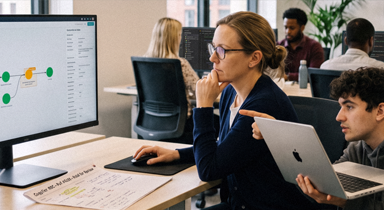
Process mining tools analyze data from business systems, and often from users' desktops, to show how processes really run and what to improve or automate.
Most process mining tools now combine process mining, task mining, and AI, which is why the category is increasingly called process intelligence.
The right tool depends on your systems, your in-house skills, and how quickly you need results.
Process mining tools analyze data from business systems to show how processes actually run, where they slow down, and where they drift from the intended path. Many now also capture desktop activity and use AI to recommend what to fix or automate.
The category has changed a lot in the last two years. Several vendors have been acquired or rebranded, new players have entered, and most tools now combine process mining with task mining and AI, a combination known as process intelligence. This guide explains what process mining tools do, the main types, how to choose one, and 25+ tools to know in 2026.
What are process mining tools?
Process mining tools collect, analyze, and visualize data from systems such as ERP and CRM applications to reconstruct how a process really runs. They compare that as-is process to the desired one, so teams can find bottlenecks, deviations, and improvement opportunities based on data rather than assumptions. For the full background, read what process mining is and how it works.
Most organizations still rely on expert-led process analysis: stakeholder interviews, surveys, workshops, and manual data crunching. It works, but it's costly and hard to scale. Process mining tools replace much of that manual effort with continuous, data-driven analysis.
[@portabletext/react] Unknown block type "imageWithAlt", specify a component for it in the `components.types` prop
Infographic: what is included in process intelligence software
Types of process mining and process intelligence tools.
Process mining tools fall into a few broad types, and many products now cover more than one:
Process mining software: extracts process data from event logs in enterprise systems.
Task mining software: collects data from users' workstations to show how individual tasks are done across applications.
Process discovery software: uses process or task data to map the as-is state of a process, often to find automation opportunities.
Hybrid process intelligence: combines process mining, task mining, and process discovery in one solution.
Self-built process analytics: dashboards built in-house, for example, with Excel for data crunching and a BI tool for visualization.
Hybrid tools sit under the broader umbrella of process intelligence, which connects process analytics to the practical work of improving how processes run.
How to choose a process mining tool.
Before choosing a vendor, you should compare tools on these criteria:
Analytics and reporting: root cause analysis, simulation, real-time reporting, and customizable dashboards.
Data coverage: process mining, task mining, or both, and how much of your work each can see.
Ease of use: how quickly business users can get value without data science support.
Integration: connections to your existing systems and data sources, without long implementations.
Path to action: whether insights lead directly to automation, or need another tool.
Scalability: support for more processes, users, and data as your program grows.
Security and compliance: encryption, access control, and handling of personal data.
Total cost of ownership: licensing, implementation, training, and ongoing support.
If possible, test a tool on one of your real processes before deciding. See how process mining works in Decisions for an example of what a first analysis looks like.
Decisions process mining datasheet.
See how Decisions combines process and task mining, what you can analyze, and how fast you can get first insights.
The tools below are grouped by type. Descriptions are based on each vendor's public materials and analyst announcements as of October 2026.
Hybrid process intelligence.
1. Decisions Process Intelligence.
Decisions combines process mining and task mining in one natively integrated, AI-powered solution, built on technology from Workfellow. It's part of the wider Decisions process intelligence platform, so teams can move from insight to automation in one place.
Generates event logs automatically by collecting data from user interfaces, so it doesn't depend on access to system logs.
Tracks tasks and process flows across business apps for end-to-end analysis.
Ready-made dashboards, root cause analysis, and what-if simulation.
Privacy first: designed not to process personally identifiable data.
Who it's for: organizations without large in-house data science or process mining teams that want fast process insight and a direct path to automation.
[@portabletext/react] Unknown block type "imageWithAlt", specify a component for it in the `components.types` prop
Process mining in automation and enterprise suites.
2. Celonis.
Celonis is one of the longest-established process mining vendors. Its Process Intelligence Platform uses a Process Intelligence Graph and object-centric process mining to create a digital twin of business operations. Celonis was named a Leader in the 2025 Gartner® Magic Quadrant™ for Process Mining Platforms.
Key features:
Object-centric process mining across systems such as SAP and Oracle.
Tools to identify AI use cases and build or orchestrate agents alongside existing automation.
A large partner network for implementation.
Who it's for: large enterprises with complex, ERP-heavy processes and the resources for a broad transformation program.
3. UiPath Process Mining.
UiPath Process Mining is part of the UiPath automation platform and is based on ProcessGold, which UiPath acquired in 2019. UiPath positions process and task mining as the starting point for agentic automation.
Key features:
Process mining and task mining connected to UiPath automation and agents.
Extensive training and certification through UiPath Academy.
Who it's for: enterprises already using UiPath that want insight and automation in one suite.
4. IBM Process Mining.
IBM Process Mining joined IBM's portfolio in 2021 through the acquisition of myInvenio. It discovers, monitors, and improves processes using data from enterprise systems.
Key features:
Discovers business rules from event logs and adds them to BPMN models.
Process graphs, variant analysis, and conformance checking.
Simulation of to-be processes and what-if scenarios.
Who it's for: organizations building on IBM software and consulting, especially teams aligning with BPMN standards.
5. Microsoft Power Automate Process Mining.
Microsoft acquired Minit in 2022 and has since built its capabilities into Power Automate as process mining.
Key features:
Process mining and task mining within the Microsoft Power Platform.
Ready-made templates and connections to Microsoft data sources.
A direct path from insights to Power Automate flows.
Who it's for: organizations standardized on Microsoft 365 and the Power Platform.
6. SAP Signavio Process Intelligence.
SAP Signavio Process Intelligence is part of SAP's business transformation suite, alongside process modeling and governance tools. SAP updates it on a regular release cycle, including AI features such as text-to-process modeling.
Key features:
Process mining with close links to SAP systems.
Process analysis, modeling, and governance in one suite.
Who it's for: SAP customers, especially those planning a move to SAP S/4HANA.
7. ServiceNow Process Mining.
ServiceNow Process Mining is built into the ServiceNow platform and mines the audit logs of ServiceNow workflows directly, without a separate data extraction step.
Key features:
Native mining of ServiceNow workflows and AI agent execution logs.
Task mining for desktop activity, and external data through Workflow Data Fabric.
Plain-language explanations of bottlenecks with Now Assist.
Who it's for: teams running high-volume IT, HR, customer service, and procurement workflows on ServiceNow.
8. Appian Process HQ.
Appian's process mining began with its 2021 acquisition of Lana Labs and is now part of Process HQ, which combines process mining with Appian's data fabric and AI.
Key features:
Process mining connected to the Appian data fabric.
Insights that flow into Appian workflow automation.
Who it's for: Appian customers, especially in financial services, insurance, and the public sector.
9. Pega Process Mining.
Pega's process mining is based on Everflow, which Pega acquired in 2022, and now sits alongside Pega Task Mining. Pega was named a Leader in the 2026 Gartner® Magic Quadrant™ for Process Intelligence.
Key features:
Process mining and task mining in the Pega Infinity suite.
Mined insights feed into Pega Blueprint, its AI design agent, to simulate and design new workflows.
Who it's for: Pega customers with customer engagement and case-heavy operations.
10. ARIS Process Mining.
ARIS was one of the first commercial process mining tools, with deep roots in process modeling and enterprise architecture. Previously part of Software AG, ARIS is being set up as a standalone business.
Key features:
Automated root cause analysis.
Process models enriched with real performance data.
Process performance management based on mining insights.
Who it's for: organizations that combine process mining with process modeling and enterprise architecture work.
11. iGrafx.
iGrafx is a business process management vendor founded in 1987. It added process mining through the acquisition of Logpickr, a French process mining company.
Key features:
Process modeling, analysis, mining, and automation in one platform.
Who it's for: enterprises that want process modeling and process mining from one vendor.
12. QAD Process Intelligence.
QAD Process Intelligence is based on LiveJourney, which QAD acquired in 2022. QAD focuses on manufacturing and supply chain organizations.
Key features:
Process intelligence focused on manufacturing and supply chain processes.
A proof-of-capability offer to test it on your own data.
Who it's for: manufacturers and supply chain teams, especially QAD ERP users.
13. ABBYY Timeline.
ABBYY Timeline is ABBYY's process intelligence platform. ABBYY also offers it to consulting partners and pairs it with analytics for its document processing products.
Key features:
Recording, analysis, and recommendations on which tasks to automate.
Task mining with privacy controls that remove sensitive information.
Who it's for: organizations with document-centric workflows, especially ABBYY customers.
14. Automation Anywhere Process Discovery.
Automation Anywhere added process discovery through its 2021 acquisition of FortressIQ. It uses computer vision to capture desktop activity and is part of the Automation Anywhere platform.
Key features:
Desktop activity capture to find automation candidates.
A direct connection to Automation Anywhere's automation tools.
Who it's for: enterprises using Automation Anywhere for automation.
Specialist process mining tools.
15. Apromore.
Apromore was founded by university professors and keeps strong ties to academia, including the University of Melbourne. It was named a Leader in the 2025 Gartner® Magic Quadrant™ for Process Mining Platforms.
Key features:
A dedicated enterprise process mining platform.
Free access for education and research.
Who it's for: enterprises wanting a dedicated process mining platform, and universities teaching process mining.
16. mindzie.
mindzie is a process mining company founded in 2020 in Texas. It was named a Major Contender and Star Performer in the Everest Group Process Mining Products PEAK Matrix® Assessment 2025.
Key features:
Low-code process mining, in the cloud or on the desktop.
Who it's for: mid-size businesses starting with process mining.
17. QPR ProcessAnalyzer.
QPR Software was one of the first vendors to offer process mining. Its ProcessAnalyzer offers broad analytics, customizable dashboards, and BPMN modeling.
Key features:
Snowflake integration for cloud data storage.
On-premise installation as an option.
Who it's for: organizations that need on-premise deployment or already use Snowflake.
18. mpmX.
mpmX, formerly MEHRWERK ProcessMining, is a modular process mining platform built on Qlik. Fortino Capital acquired MEHRWERK in 2025.
Key features:
Process mining inside Qlik, with self-service dashboards.
A wide range of data connectors.
Who it's for: organizations already using Qlik for business intelligence.
19. process.science.
process.science is a German process mining solution that runs inside Qlik and Power BI.
Key features:
Process mining within existing BI tools, at a relatively low cost.
Who it's for: BI teams that want to add process mining to their current dashboards.
20. Inverbis Analytics.
Inverbis is a Spanish process mining company that grew out of CiTIUS, the Research Center on Intelligent Technologies at the University of Santiago de Compostela.
Key features:
Predictive SLA tracking.
AI-based root cause analysis.
Who it's for: organizations that want predictive process monitoring.
21. Fluxicon Disco.
Disco is a process mining tool from Fluxicon, a company with roots in academic process mining research.
Key features:
Simple licensing.
An active community of process mining practitioners.
Who it's for: analysts and teams getting started with process mining at a modest cost.
22. Futuroot.
Futuroot is a newer process mining vendor assessed in the Everest Group Process Mining Products PEAK Matrix® Assessment 2025.
Key features:
Built-in object-centric process mining.
Who it's for: manufacturing and healthcare organizations.
Task mining and process discovery tools.
23. Skan.ai.
Skan.ai uses computer vision, natural language processing, and deep learning to observe how people work and turn that activity into a model of how the enterprise operates.
Key features:
Computer vision-based process discovery.
Process context that AI agents can use to take over repetitive work.
Who it's for: large operations teams with desktop-heavy work.
24. KYP.ai.
KYP.ai describes itself as an agentic process intelligence platform. It was named a Strong Performer in The Forrester Wave™: Process Intelligence Software, Q3 2025.
Key features:
A live view of workforce, process, and technology data.
Business cases that rank automation opportunities by return.
Who it's for: shared services, BPO, banking, and insurance operations leaders.
25. Soroco Scout.
Soroco's Scout builds a Work Graph from how teams work across applications, covering both task discovery and process discovery.
Key features:
Task and process discovery in one product.
Who it's for: enterprises with knowledge work spread across many applications.
26. StereoLOGIC.
StereoLOGIC, based in Toronto, offers task capture and process mining focused on digital transformation.
Key features:
Task mapping that filters out interruptions and noise.
Removal of confidential client and employee data.
Who it's for: organizations in regulated industries.
Open-source process mining.
27. ProM.
ProM (Process Mining framework) is a free, open-source framework of process mining algorithms, widely used in research.
Who it's for: researchers and teams with the skills to build their own process mining capabilities.
Choosing the right process mining tool for you.
There's no single best process mining tool. Enterprise suites suit organizations already invested in that vendor's platform. Specialist tools suit teams that want deep analysis or a low-cost start. Task mining tools suit work that happens mostly on desktops. Hybrid process intelligence suits teams that want the full picture quickly and want to act on it in the same platform. Shortlist two or three tools that match your systems and skills, then test them on a real process.
See Decisions Process Intelligence on your own process.
Get a walkthrough of how Decisions combines process and task mining, and what it could find in your workflows.
Process mining tools are software that analyze event data from business systems to reconstruct how processes really run. They compare the actual process to the intended one, so teams can find bottlenecks, deviations, and automation opportunities based on data instead of interviews and workshops.
What is the difference between process mining tools and task mining tools?+−
Process mining tools use event logs from systems such as ERP and CRM to map end-to-end processes. Task mining tools capture activity on users' desktops, such as clicks and keystrokes, to show how individual tasks are done. Hybrid process intelligence tools combine both.
How do I choose a process mining tool?+−
Start with where your processes run, how much work happens outside core systems, and your in-house skills. Then compare tools on analytics, data coverage, ease of use, integration, the path to automation, security, and total cost. Test your shortlist on one real process before deciding.
What is the difference between process mining and process intelligence?+−
Process mining is a subset of process intelligence. Process mining analyzes event logs from specific systems. Process intelligence combines process mining, task mining, and analytics across the organization, and connects those insights to monitoring, improvement, and automation.
15 October 2026
Point Tools vs. Platform: What Happens When Orchestration Isn't Native